
A research programme at icipe · Nairobi & Mbita, Kenya
Nature found a way.
We’re learning to use it.
Deep inside malaria-carrying mosquitoes, a naturally occurring microbe blocks the parasite from transmitting to humans. SYMBIOVECTOR is the research programme at icipe working out how to let that microbe do its job at scale.

Researcher examining mosquito cage, icipe. Credit: Thomas Onchuru / icipe.
597K
malaria deaths in 2023, mostly children under 5 (WHO 2024)
263M
malaria cases per year, 95% in Africa
Breakthrough 2021
Falling Walls Award, Berlin
~8yr
target: discovery to impact, vs ~20yr field average
Breakthrough of the Year · Falling Walls 2021
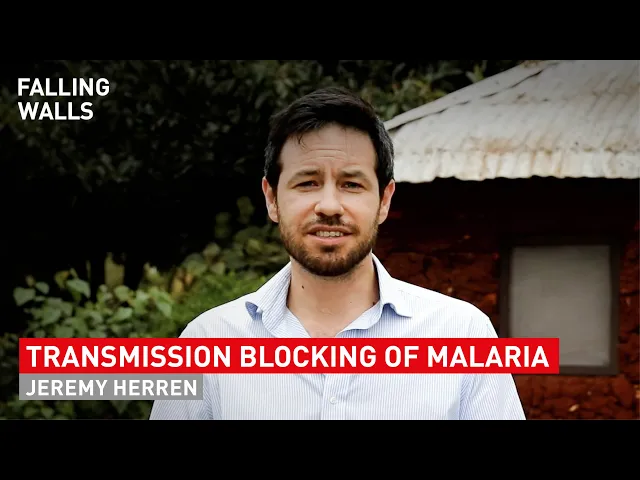
Hear Dr Jeremy Herren explain the science
In November 2021, SYMBIOVECTOR principal investigator Jeremy Herren was awarded Breakthrough of the Year at the Falling Walls conference in Berlin - one of the world’s most prestigious science communication stages. In this talk, he explains what Microsporidia MB is, how it blocks malaria, and why the symbiont approach could change how we think about vector control.
11 minutes. Worth watching.
Jeremy Herren, Falling Walls Conference, Berlin, 2021.
The Science
A microbe that already solves the problem
Microsporidia MB is a naturally occurring organism that lives in Anopheles arabiensis - one of the main malaria-carrying mosquitoes in Africa. Mosquitoes infected with Microsporidia MB are far less likely to transmit malaria to people.. The microbe doesn’t harm the mosquito. And it was already there.
Discovery
Found in the wild
Identified at icipe in wild Anopheles arabiensis populations in Kenya. Published in Nature Communications in 2020. The finding: a naturally occurring microbe that blocks 100% of malaria transmission in infected mosquitoes.
Transmission
How it spreads
Microsporidia MB passes from mother to offspring, and also spreads sexually during mating. This means it can establish and spread in wild mosquito populations - without continuous intervention once conditions are right.
Current focus
Lifting prevalence
The programme’s current phase focuses on increasing infection density: optimising mass-rearing, spore production, and conditions that let Microsporidia MB thrive at population scale. This is the hard problem we’re working on.

Confocal fluorescence microscopy: mosquito egg containing Microsporidia MB (red) within an Anopheles arabiensis egg (green). Produced at icipe. Credit: Thomas Onchuru / icipe.
Visualising the symbiont
Seen under the microscope for the first time
These fluorescence images - produced at icipe - show Microsporidia MB localised within an egg of Anopheles arabiensis.
Understanding the symbiont’s lifecycle at the cellular level is what drives the next question: how do we create the conditions for it to reach high prevalence in wild populations?
Read the research →
Our Approach
Working with nature, not around it
The instinct in biology is often to engineer solutions - to modify, override, or suppress. Symbionts offer a different starting point. We’re not introducing anything foreign. Microsporidia MB is already inside these mosquitoes. Our work is to understand it well enough to let it do more of what it already does.
That matters for safety, for community acceptance, and for regulatory pathways.

Naturally occurring
Microsporidia MB is found in wild mosquito populations. Nothing is engineered or introduced.

Avirulent
The symbiont doesn’t harm its mosquito host. No fitness cost - which matters for spread.

Self-spreading
Passed vertically and sexually, Microsporidia MB can establish in wild populations without ongoing release.

Socially acceptable
Community acceptability is studied as part of the programme, not assumed. Structured engagement and awareness work runs alongside the transmission research at our Mbita field site.
Home of the research
Based at icipe - Africa’s leading tropical insect science institute
SYMBIOVECTOR is a programme within icipe - the International Centre of Insect Physiology and Ecology, headquartered in Nairobi with a key field station in Mbita on Lake Victoria.
icipe has spent over 50 years building the scientific infrastructure, field networks, and community relationships that make this kind of research possible. SYMBIOVECTOR benefits directly from that foundation - and from the breadth of cross-disciplinary expertise icipe brings together.

Founded 1970 · 50+ years of science
icipe is one of Africa’s oldest and most respected international research institutions.

Nairobi headquarters · Mbita field station
SYMBIOVECTOR’s lab and field work is based in Kenya, close to the communities most affected by malaria.

African-led, globally connected
Research grounded in Africa, in partnership with institutions across the continent and internationally.

Training the next generation
The SYMBIOVECTOR team has mentored postdocs, PhD, and MSc students through its work at icipe.

Community engagement session, western Kenya. Credit: Thomas Onchuru / icipe.

Insectary, icipe Mbita campus. Credit: Thomas Onchuru / icipe.

Screenhouse, icipe. Credit: Thomas Onchuru / icipe.
From Lab to Community
Science that has to work in the real world
SYMBIOVECTOR research runs across two settings - the controlled environment of the insectary, and the messy reality of the field.
Mbita puts the research close to communities that have lived with malaria for generations. An intervention that communities don't trust won't work at scale - so understanding how people think about Microsporidia MB, and building that trust, is built into the field work from the start.
Semi-field experiments in screenhouses bridge the gap - realistic mosquito behaviour, controlled enough to measure what matters.
The Team
The people behind the programme
SYMBIOVECTOR isn’t one person’s project. It’s a group of people who think the problem is important, take the work seriously, and try to be decent to each other while doing it. That’s the culture we’re building. The core team is based at icipe’s Nairobi campus, with field work centred at Mbita on Lake Victoria.
Research & Project Management

Dr Jeremy Herren
Principal Investigator & Senior Scientist
icipe
Jeremy is a molecular biologist specialising in insect symbiosis and the Principal Investigator of SYMBIOVECTOR. Since joining icipe in 2014, he has led the discovery of Microsporidia MB - a naturally occurring microbe in malaria-transmitting mosquitoes that blocks Plasmodium transmission to humans — and built the interdisciplinary team to advance it. That discovery earned him Breakthrough of the Year 2021 at the Falling Walls conference in Berlin. He holds a PhD from EPFL Lausanne.
Insect symbiosis · Malaria transmission · Programme leadership

Dr Syeda Tullu Bukhari
Research Scientist
icipe · Nairobi
Tullu is a medical entomologist and SYMBIOVECTOR scientist based at icipe’s Nairobi campus. Her work focuses on understanding Microsporidia MB transmission efficiencies in relation to mosquito genetic background, environment, and behaviour, to inform a real application strategy. She is also committed to community involvement: creating awareness and ensuring long-term acceptability of Microsporidia MB-based interventions. She holds a PhD in Medical Entomology from Wageningen University, Netherlands.
Medical entomology · Community-level control · Nairobi

Dr Thomas Ogao Onchuru
Research Scientist
icipe · Nairobi
Thomas is a molecular biologist investigating the mechanisms by which Microsporidia MB spreads through mosquito populations and blocks Plasmodium transmission - including localization, transmission routes, and what those mean for a real release strategy. He holds a PhD from Johannes Gutenberg University Mainz and the Max Planck Institute for Chemical Ecology, Germany, where his thesis focused on the defensive role of gut-associated microbes in insects. Co-author on key Microsporidia MB papers including the vertical transmission work in PLOS Pathogens.
Insect-microbe interactions · Molecular biology

Dr Priscille Barreaux
Associate Scientist
icipe · Nairobi
Priscille is an expert in vector-borne disease control, host-parasite interactions, and behavioural ecology. Within SYMBIOVECTOR, she uses video-tracking, lab work, and semi-field experiments to study how Microsporidia MB-infected mosquitoes adapt their behaviour under stress - understanding this is key to maximising the survival and reproductive success of infected mosquitoes in the field. She holds a PhD from the University of Neuchâtel, and was previously a Postdoctoral Research Associate at the Liverpool School of Tropical Medicine.
Behavioural ecology · Insecticide resistance · Field methods

Dr Lilian Mbaisi Ang’ang’o
Postdoctoral Fellow
icipe · Thomas Odhiambo Campus, Mbita
Dr. Mbaisi specialises in vector biology, genomics, and malaria transmission-blocking symbionts. Her work focuses on the bioinformatics of Microsporidia MB - its genomics and strain analysis from isolates collected across different regions - and on investigating the blocking effect in malaria vectors using membrane feeding assays. She completed her PhD as an OWSD Fellow at Rhodes University’s Research Unit for Bioinformatics (RUBi).
Bioinformatics · Genomics · Mbita

Dr Daniel Masiga
Principal Research Scientist
icipe · Head of Human Health
Dr. Masiga heads the Human Health division at icipe, where SYMBIOVECTOR is domiciled. His research employs genomics and bioinformatics to uncover emerging infectious disease threats - particularly those transmitted by mosquitoes, ticks, and sand flies. He also leads postgraduate bioinformatics training across Africa, mentoring the next generation of African scientists.
Vector biology · Genomics · Capacity building

Benjamin Gräub
Project Manager - Partnerships, Fundraising & External Relations
Consultancy · June 2026–May 2027
Benjamin brings 15+ years working across agrifood systems — at FAO, FiBL, and as co-founder of farmbetter. His role is external-facing: funding relationships, new partnerships, communications, and policy engagement.
Partnerships · Fundraising · Communications
SYMBIOVECTOR involves a large group of PhD students, MSc students, research officers, and assistants based primarily at icipe’s Nairobi and Mbita campuses.
Affognon Steven · PhD / Godfred Boanyah · PhD / Jacqueline Waweru · PhD / Edward Makhulu · PhD / Fidel Gabriel Otieno · MSc / Cynthia Kingori · MSc / Khadija Nyendesi Juma · MSc / Beth Kinya Kimathi · MSc / Shisia Aclaine · MSc / Mwaura Esther Wairu · MSc / Bevalyne Achieng Oduor · MSc / Antoney Mutai · Research Officer / Cassandra Ronnie · Research Assistant / Gerald Ronoh · Research Assistant / Jennifer Thiong’o · Research Assistant / Peris Wambui · Research Assistant / Stancy Mandere · Research Assistant / Ian Okello · Research Assistant / Naomi · Research Assistant
Partnerships
Science works better together
SYMBIOVECTOR is built on the premise that malaria won’t be solved by one lab in one country. These partnerships are not window dressing — they’re how the science actually gets done.

Active collaboration · UofG
University of Glasgow
Prof Steven Sinkins · MRC-University of Glasgow Centre for Virus Research. Parallel work on symbiont-based disease control makes this one of the closest scientific partnerships in the programme.

Active collaboration · IPM
Institut Pasteur de Madagascar
Antananarivo, Madagascar. The Institut Pasteur de Madagascar is one of the continent’s leading biomedical research centres, with deep expertise in vector-borne and infectious diseases. The SYMBIOVECTOR partnership extends the programme’s field reach to a different malaria epidemiological context and vector population - critical for understanding how broadly Microsporidia MB can work.

Active collaboration · RBC
Rwanda Biomedical Centre
Kigali, Rwanda. The Rwanda Biomedical Centre (RBC) is Rwanda’s national public health institution, overseeing disease control and health research across the country. The SYMBIOVECTOR partnership with RBC connects laboratory research directly to national malaria control infrastructure - an important link as the programme moves toward real-world application.

Active collaboration · ICL
Imperial College London
London, United Kingdom. Imperial College London brings world-class expertise in infectious disease modelling, epidemiology, and global health to the SYMBIOVECTOR alliance. The UK partnership complements the African-led field and laboratory work with analytical and translational capacity - essential for making the case to regulators and funders as the programme scales.
Interested in collaborating? We’re actively building the alliance.
Email us →
The Bigger Picture
From discovery to impact — faster, together
The typical path from scientific discovery to public health impact takes around 20 years. We think that’s too long, and that coordinated, well-resourced African science can compress it. The longer-term vision is a SYMBIOVECTOR alliance - 4 to 5 African universities linked through a shared data hub, working together on symbiont-based disease control.

Malaria first
Microsporidia MB in Anopheles arabiensis is the proof of concept. Get this right and the model scales to other diseases and vectors.

African-led
Research at icipe, in Kenya, by scientists embedded in the region.

Faster together
An AI-enabled data alliance across institutions can compress what takes decades into years. That’s the ambition we’re building toward.
Evidence
Key publications
Supported by
Get in Touch
We’d like to hear from you
Whether you’re a researcher interested in collaboration, a journalist covering malaria or vector control, or someone who simply wants to understand the science better - write to us. For scientific collaboration, media enquiries, or questions about the programme, one address reaches the right person:
contact@symbiovector.com →
We hear from
🔬 Researchers interested in scientific collaboration or data sharing
🤝 Institutions exploring partnership opportunities
📰 Journalists and science communicators covering malaria or vector control
🎓 Students and postdocs interested in joining the programme
🌍 Policy and public health professionals working on malaria control
A research programme at icipe · Nairobi & Mbita
Nature found a way. We’re learning to use it.
Deep inside malaria-carrying mosquitoes, a naturally occurring microbe blocks the parasite from transmitting to humans. SYMBIOVECTOR is the research programme at icipe working out how to let that microbe do its job at scale.
597K
malaria deaths reported globally in 2023
263M
malaria cases per year — a prevention gap still measured at planetary scale
2021
Breakthrough of the Year at Falling Walls for the Microsporidia MB discovery
~8yr
target from discovery to field-ready impact pathway
Hear Jeremy explain the science
In 2021 Jeremy Herren was awarded Breakthrough of the Year at Falling Walls in Berlin. In this talk, he explains what Microsporidia MB is, how it blocks malaria, and why the symbiont approach could change vector control.
The Science
A microbe that already solves the problem
Discovery
Found in the wild
Identified at icipe in wild Anopheles arabiensis populations in Kenya. The finding: a naturally occurring microbe that blocks malaria transmission.
Transmission
How it spreads
Microsporidia MB passes from mother to offspring, and also spreads sexually during mating.
Current focus
Lifting prevalence
The programme focuses on mass-rearing, spore production, and conditions that let Microsporidia MB thrive at population scale.
Working with nature, at icipe, toward impact
SYMBIOVECTOR works with a naturally occurring symbiont already found in mosquitoes. The programme is based at icipe in Nairobi and Mbita, building toward an African-led alliance for symbiont-based disease control.
Naturally occurring
Nothing is engineered or introduced. The work is to help what is already there spread safely.
African-led
Research at icipe, in Kenya, by scientists embedded in the region and globally connected.
From Lab to Community
Science that has to work in the real world
Community engagement session, western Kenya. Credit: Thomas Onchuru / icipe.
Insectary, icipe Mbita campus.
Screenhouse, icipe.
SYMBIOVECTOR research runs across the controlled environment of the insectary and the messy reality of the field. A solution that works in a lab cage but not in a village isn’t a solution.
The team works out of icipe’s Mbita campus on Lake Victoria — surrounded by communities most affected by malaria. Semi-field experiments in screenhouses bridge the gap.
Science is a team sport
Dr Jeremy Herren
Principal Investigator
icipe · SNSF Fellow
Jeremy leads SYMBIOVECTOR and was awarded Breakthrough of the Year 2021 at Falling Walls for the Microsporidia MB discovery.
Programme leadership
Dr Syeda Tullu Bukhari
Research Scientist
icipe · Nairobi
Tullu is a medical entomologist based at icipe’s Nairobi campus and works on transmission efficiency, environment, behaviour, and community acceptability.
Medical entomology · Nairobi
Dr Priscille Barreaux
Postdoctoral Fellow
icipe · Nairobi
Priscille is an expert in vector-borne disease control, host-parasite interactions, and behavioural ecology.
Behavioural ecology · Field methods
Dr Thomas Ogao Onchuru
Postdoctoral Fellow
icipe · Nairobi
Thomas is a molecular biologist investigating how Microsporidia MB spreads through mosquito populations and blocks Plasmodium transmission.
Insect-microbe interactions · Molecular biology
Show more team members
Science works better together
SYMBIOVECTOR is built on active scientific collaboration with the University of Glasgow, Institut Pasteur de Madagascar, Rwanda Biomedical Centre, and Imperial College London.
Active collaboration · UofG
University of Glasgow
Prof Steven Sinkins and his team bring complementary symbiont-based vector control expertise to the programme.
Active collaboration · IPM
Institut Pasteur de Madagascar
Antananarivo, Madagascar. Extends the programme’s field reach to a different malaria epidemiological context and vector population.
Active collaboration · RBC
Rwanda Biomedical Centre
Kigali, Rwanda. Connects laboratory research directly to national malaria control infrastructure.
Active collaboration · ICL
Imperial College London
London, United Kingdom. Adds infectious disease modelling, epidemiology, and translational capacity to the alliance.
Key publications
2026 — Modelling the temporal dynamics of Microsporidia MB prevalence in Anopheles mosquitoes · Scientific Reports
2026 — Laboratory Anopheles gambiae s.l. mosquito colonies show sustained high transmission of Microsporidia sp. MB · Frontiers in Cellular and Infection Microbiology
2025 — Maximizing horizontal transmission through mating · Malaria Journal
Show more publications
Get in Touch
We’d like to hear from you
Whether you’re a researcher, journalist, student, policy professional, or simply want to understand the science better — one address reaches the right person.
contact@symbiovector.com →
🔬 Researchers interested in scientific collaboration or data sharing
🤝 Institutions exploring partnership opportunities
📰 Journalists and science communicators
🎓 Students and postdocs
🌍 Policy and public health professionals
Supported by
SYMBIOVECTOR
A malaria transmission-blocking research programme at icipe. Email us at contact@symbiovector.com. icipe.org
SYMBIOVECTOR Research Group